

The first thing I want to tell you is that I did not want to like this bottle. I am 58, I live in Asheville, and I have watched a lot of supplement marketing slide past my eyes over the years. When my knees started complaining on the stairs first thing in the morning, my instinct was to buy better shoes and ignore it. That worked for about a year. Then it stopped working.
So this is the honest version of my Osteo Bi-Flex story, not the brochure version. I have been taking it for 24 months. It has helped me in one specific, unglamorous way. It has also given me two complaints I have never seen mentioned on the front of the bottle. All of it is in here, and I am not going to bury the complaints at the bottom of the page.
The Quick Verdict
Two years in, the morning stairs got a little easier around week eight. The tablets are big enough that I had to change how I take them.
Amazon Check Today's Price →Two years of my own money, one bottle, and the same question you are asking
I bought mine at the same store you would. If you want to see today's price and read the label the way I read it, the listing is below. Read the serving line on the back before you do the arithmetic on the count.
Amazon Check Today's Price on Amazon →What Nobody Tells You First
Here is the thing I wish someone had said out loud to me in the aisle. Before you assume that the number on the front of the bottle tells you how long it lasts, read the serving line on the back. The serving size is the detail that decides everything, and it is printed in small type down where you have to go looking for it. I did not look. I did the division in my head with a number I had guessed at and came home pleased with myself.
The bottle holds 120 tablets. That much sits on the label in plain sight. How many of those tablets make up one serving is a separate question, and it is the one that matters. I am not going to do that arithmetic for you, because it is yours to do with your own eyes on the actual label, but I will say this much. Do it in the store, standing there, before you decide. Not three weeks later at the kitchen table.
I am not going to pretend I did not grumble about this. I grumbled for a solid week. Then I rearranged the cabinet, moved the bottle next to the coffee, and got on with it, which is roughly how most of my fifties have gone.
The second thing nobody tells you is the size. These are big tablets. Not the largest I have ever swallowed, but close. For the first week I dreaded them, and I am not being dramatic when I say the logistics of getting them down occupied more of my morning than the supplement did.
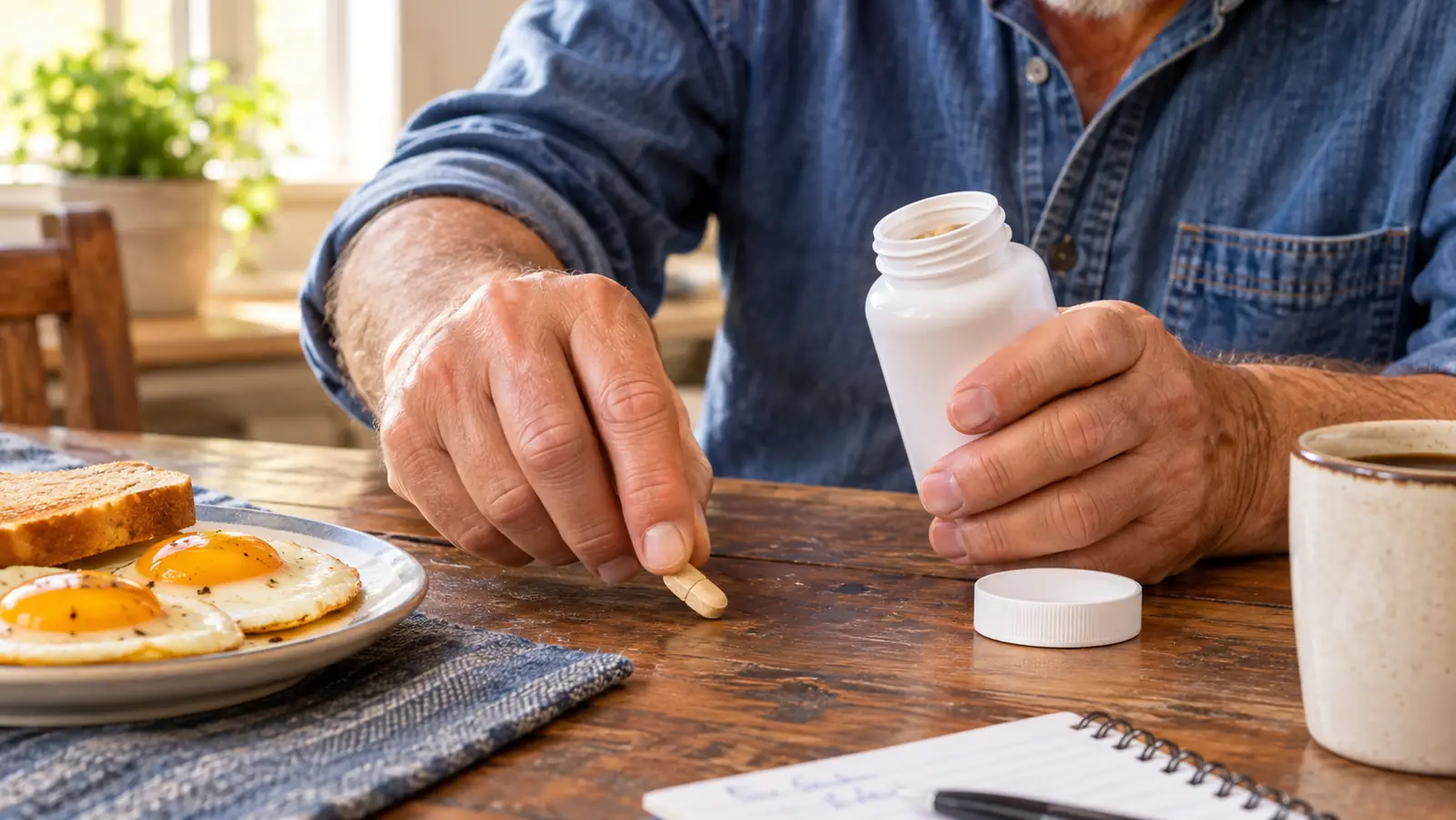
My fix was simple and it took me longer to find than it should have. I take them with breakfast, mid-meal, with a full glass of water, and I do not try to take the whole serving at once. One, a bite of eggs, the next one, another bite. Sounds silly written down. It is the reason I am still taking this at month 24 instead of month two.
The third thing is the footprint. This is a real bottle, 10.4 ounces and about 5.25 by 6.81 by 6.81 inches, and it does not fit in the little basket on my bathroom shelf with everything else. Mine lives in the kitchen cabinet next to the coffee, because I take it with breakfast. That turned out to be a good arrangement anyway, since the kitchen is where the water glass is.
What Is Actually in the Bottle
I read the whole panel before I started and then I called Dr. Lowe's office with a question. That is not a flex, it is just what I do now. I am not a nurse, a dietitian, or a trainer. I am a retired high school office manager who reads labels, and I want that line drawn clearly before we go any further.
The label lists glucosamine HCl and chondroitin as primary supplement types, along with vitamin C, and the listing names 5-Loxin Advanced, which the bottle describes as a concentrated herbal extract. The form is a tablet. The bottle is gluten free. That is the whole of what I can tell you from the label, and it is more than most people read before they buy.
What it is not: it is not a pain reliever. It does not behave like the bottle of ibuprofen in the cabinet, and it does not work as fast. Anyone who tells you they felt something on day two is either describing something else or selling something. My own timeline was closer to eight weeks.
It is also not a substitute for a conversation with your doctor or pharmacist. I mean that plainly. If you take blood thinners or any other medication, ask before you start. If you are pregnant, ask. If you have a shellfish allergy, ask specifically about that, because glucosamine sources vary and this is exactly the kind of question a pharmacist answers in thirty seconds and a website cannot.
About eight weeks in, I came down my 14 stairs to the kitchen one morning and realized I had not thought about my knees on the way down. I had thought about coffee. That was the whole result.
The Timeline, Honestly, Month by Month
I kept a small notebook. Not a spreadsheet, just a few lines a week, because I wanted to be able to tell myself the truth about whether this thing was doing anything. Here is what is in it.
Months one and two: nothing. I want to be very clear. For the first several weeks I noticed no difference at all and I was fairly sure I had bought an expensive habit. I kept going mostly because I had paid for it and because I am stubborn.
Around week eight something small changed. I came down the stairs one morning, got to the bottom, and realized I had not braced myself on the railing. That had become automatic over the previous year, a hand on the rail for the first three steps. That morning I just walked down. My knees felt a little less stiff first thing, and I noticed it only because it was absent.
That is the entire result. Not dramatic. It did not make me faster on the pickleball court and it did not touch my right shoulder, which still gets stiff the morning after I play. It made the first twenty minutes of my day feel less creaky, and that has held, more or less, for two years.
Around month six I had a stretch where my knees felt worse again. I panicked and assumed the tablets had quit. Then I looked at my notebook and realized I had played pickleball three times that week instead of twice and had done a longer Saturday hike. It was not the tablet. It was me overdoing it. Worth saying, because it is easy to credit or blame a bottle for something your own calendar did.
I took a two week break at the four month mark, which is what I did between all the products I tried, and I will not pretend the break told me anything useful. Nothing dramatic happened in either direction. Two weeks is not long enough to learn much and I would not repeat the exercise.
Where Osteo Bi-Flex Surprised Me, and Where It Did Not
It surprised me on the stairs. That is one specific motion, first thing in the morning, and it has been consistently better for two years. I did not expect a tablet to touch something that specific and that small, and it did.
It surprised me on downhill stretches, but not the way I hoped. Downhill is still the thing that finds my knees. What changed is the recovery. On a Saturday hike with a lot of descent I used to feel it the rest of the day and into Sunday morning. Now I feel it on the descent, and by the time I am in the car it has mostly faded. The hill did not get easier. The recovery got shorter.
It did not touch my right shoulder. After pickleball that shoulder is stiff the following morning in a way that has not budged at all. I added something else for that later, and that is a separate story, but I want it on the record that Osteo Bi-Flex did nothing for it.
It also did nothing for my hands, my back, or the twinge in my hip that shows up when I garden too long in the spring. I mention that because the front of the bottle says joint health, and the word joint is broad enough that your imagination fills in the rest. What I noticed was one joint in one motion, and that is all I can tell you about.
And two years in, I will say the honest thing about longevity. A supplement you take for two years stops being exciting somewhere around month four. What kept me on it was not enthusiasm. It was that when I thought about stopping, I could point to one small change in my morning that I did not want back. That is a quieter reason than most bottles advertise, and it is the only one I actually have.
What I Liked
- Around week eight, my knees felt a little less stiff on the 14 stairs first thing in the morning, and that has held for two years.
- One tablet form. No powder to mix, no taste to get around, no shaker bottle to wash.
- The label is gluten free and lists glucosamine HCl, chondroitin and vitamin C in plain terms.
- A single bottle gives you long enough to judge it properly, once you have read the serving line on the back.
- It slotted into my morning beside the coffee without any fuss at all.
Where It Falls Short
- The tablets are big, and that is the thing most likely to make someone quit in week one.
- You will not notice anything for weeks. I did not notice anything for about eight.
- It did nothing for my right shoulder after pickleball, or for my hands, my back or my hip.
- It is not a pain reliever and it does not behave like one.
- The serving line is easy to misread, so the bottle does not last nearly as long as the count on the front suggests.
- Anyone on blood thinners, or with a shellfish allergy, has to ask a doctor or pharmacist before starting.
How It Fits in My Week Now
These days the routine is unglamorous and I prefer it that way. Osteo Bi-Flex with breakfast. Something else with lunch. Something else again with dinner. I take them one at a time, I ask Dr. Lowe before I add anything new, and then I go back to my coffee and my three miles.
Travel takes a little planning. The bottle is too big for a weekend bag, so I count out what I need into a small pill case for short trips and take the bottle for anything longer than a few days. I have forgotten it twice on overnight trips and noticed nothing in either direction, which I now take as a reminder not to overthink a missed morning.
Bev asks me about it every few months, usually on the bench between games. She has not tried it. I tell her the same thing each time: it took about eight weeks, it helped me on the stairs, and it did nothing for my shoulder. So if her complaint is her shoulder, this is probably not the thing to start with, and I would rather say that than sell her on it.

The Boring Parts That Actually Matter
The bottle is a bottle. It does not have a fancy dispenser, it does not have a day-of-the-week lid, it does not do anything clever. You open it and tablets come out. I have knocked the whole thing off the counter once and spent a stupid amount of time on my hands and knees in the kitchen. That is the entire interaction with the packaging.
If you have any trouble swallowing pills, this is not a product to start with casually. I would genuinely suggest a smaller count first, get used to the size, and then decide, rather than committing to the big bottle out of the gate the way I did.
Who This Suits
I think this suits a narrow and specific person: an active adult somewhere past fifty, with morning stiffness in the knees that has not gone away after a reasonable attempt at shoes, a mat, and some patience, who is willing to take something daily for two months before deciding whether it is doing anything. That describes my situation almost exactly, and it is why I am still taking it.
I also think it suits someone already comfortable with the idea that a supplement is a slow, unspectacular thing. If you want to feel it by Friday, save your money. I mean that without snark. There is nothing wrong with wanting something fast. It is just not what this is.
Who Should Skip It
Skip it if you struggle with large tablets. I am serious. A big tablet every morning, every day, indefinitely, is a real commitment and there is no way around the size. If a big pill is a problem for you, this is the wrong format and no amount of willpower fixes it.
Skip it if you take blood thinners or other medication and have not asked your doctor or pharmacist yet. That is not a maybe. Do the asking first. Skip it if you are pregnant, and skip it if you have a shellfish allergy without getting a specific answer about the glucosamine source first.
Skip it if you want a pain reliever, because this is not that and does not behave like that. And skip it if a daily habit is hard for you to hold. Missing a morning here and there is not a crisis, but a supplement you take four days a week is a supplement you cannot really judge.
What I Would Have Done Differently
I would have read the serving line in the store instead of assuming. And I would have bought a smaller count first, because if I had hated the tablet size, which I nearly did, I would have been stuck looking at a bottle I dreaded opening.
I would have started the notebook sooner. The first few weeks are the hardest to remember accurately, and the fact that I have a written record from week three onward is the only reason I can give you an honest timeline instead of a flattering one.
And I would have taken the label to the pharmacy counter instead of squinting at it in the aisle. The pharmacist answered a question about another product in about forty seconds that had cost me half an hour of guessing. They do not mind. It is what they are there for. Talk with your doctor or pharmacist before you start anything, including this.
If you are going to try it, read the back of the bottle before you buy
The serving line on the label decides how long a bottle really lasts, and it is the thing I got wrong in the aisle. The listing below has the count, the label and today's price. Start small if the tablet size worries you.
Amazon Check Today's Price on Amazon →One last plain thing. I am not a doctor and I am not telling you what to do. What I am telling you is what happened in my own kitchen over two years: a long wait before anything changed, one motion that got easier, a shoulder that did not budge, and a tablet big enough that I had to learn a new way to swallow it. That is the whole review. It is small and it is real, and if it sounds like your mornings, it is worth a conversation with your doctor and a look at the back of the label.