
Two springs ago I stood at the top of the stairs in our Asheville house, hand on the rail, waiting for my knees to catch up. Fourteen steps to the bedroom and every one of them had an opinion that first half hour of the day. Twenty minutes later I was fine. That is the part nobody warns you about. The stiffness does not announce itself at noon when you are busy. It shows up before you are awake enough to argue with it. I play pickleball twice a week with my friend Bev, walk about three miles most mornings, hike a local trail on Saturdays from spring to fall, and garden out back until the weeds win. I am 58. I am not looking to be talked into anything.
Turmeric is the spice that gives curry powder its color. Curcumin is the compound in it that people mean when they use the two names interchangeably on a supplement shelf, which does nobody any favors. The bottle I landed on is NatureWise Turmeric Curcumin, and it has been in the cabinet next to the plates for about 16 months now. I take the serving on the label with dinner. I am not a doctor, a nurse, a dietitian or a trainer, and nothing here is medical advice. I am a retired high school office manager who reads the back of the bottle and notices things. What follows is my routine and the questions I would ask before copying it.
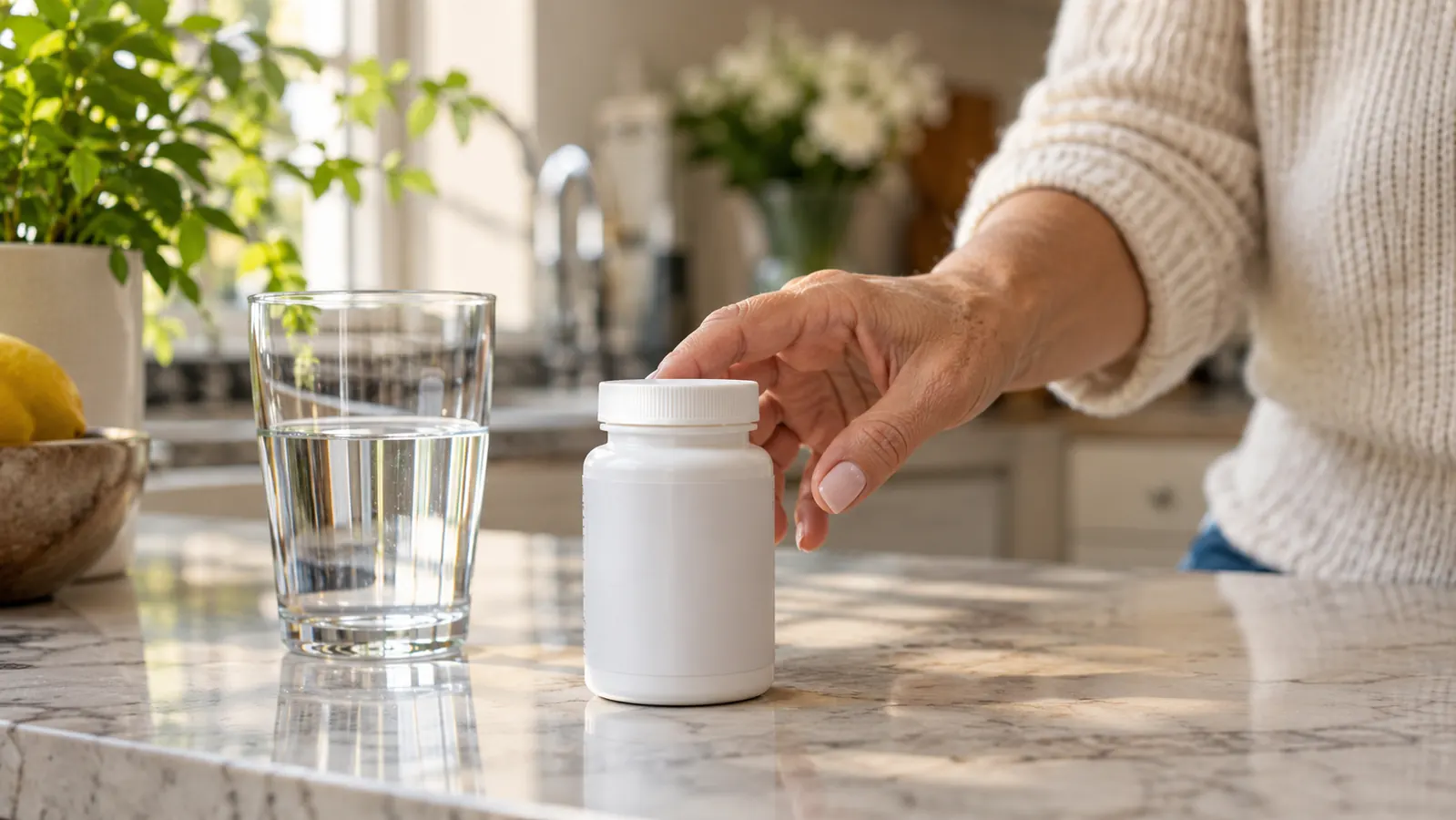
The bottle that lives next to the plates
NatureWise Turmeric Curcumin, 2250 mg per serving with BioPerine and organic ginger, 90 capsules to a bottle. Read the panel yourself before you start, and ask your doctor first if you take a blood thinner or any regular medication.
Amazon Check Today's Price on Amazon →What the NatureWise Label Actually Says
The front of the bottle reads 2250 mg, and the bottle holds 90 capsules. What I care about is further down. The listing says the curcumin is standardized to 95% curcuminoids, and that is the number I look for, because it tells you how much of the actual compound is in there rather than just how much ground root got swept into the capsule. It also lists BioPerine, a black pepper extract, and says straight out that curcumin on its own is poorly absorbed. The rest of the ingredient list is organic turmeric root, organic turmeric extract and organic ginger. It is non-GMO, the diet type is listed as vegan, and the flavor is unflavored, which is exactly what I want in something I swallow with dinner.
What it is not: it is not a pain pill, and I would not expect it to behave like one. It is a capsule, it takes up about as much room in the day as putting on a sock, and it belongs in the same category as the rest of my small daily habits, which I keep up and then mostly forget about. I read the whole back panel the first time I bought it, and I read it again every time I open a new bottle, because labels get revised and I would rather find that out in my kitchen than online.
Step 1: Ask Your Doctor or Pharmacist Before You Buy Anything
I asked Dr. Lowe before I started this, the same way I asked her before the glucosamine and before the collagen. She knows what else I take and she knows my history, which is more than a bottle can. If you take a blood thinner, or anything else on a regular schedule, that conversation matters more, not less, and a pharmacist can have it with you in about two minutes while you are already at the counter picking up something else.
If you are pregnant or nursing, ask first. If you are weeks out from a surgery, ask first. If you are already on a handful of prescriptions, bring the bottle with you instead of trying to remember the name, because the spice from the vitamin aisle is not a useful answer to a pharmacist.
This is the step people skip, and it is the only one on this list I would call non-negotiable. Everything below it is logistics.
Step 2: Take It With a Meal, Not on an Empty Stomach
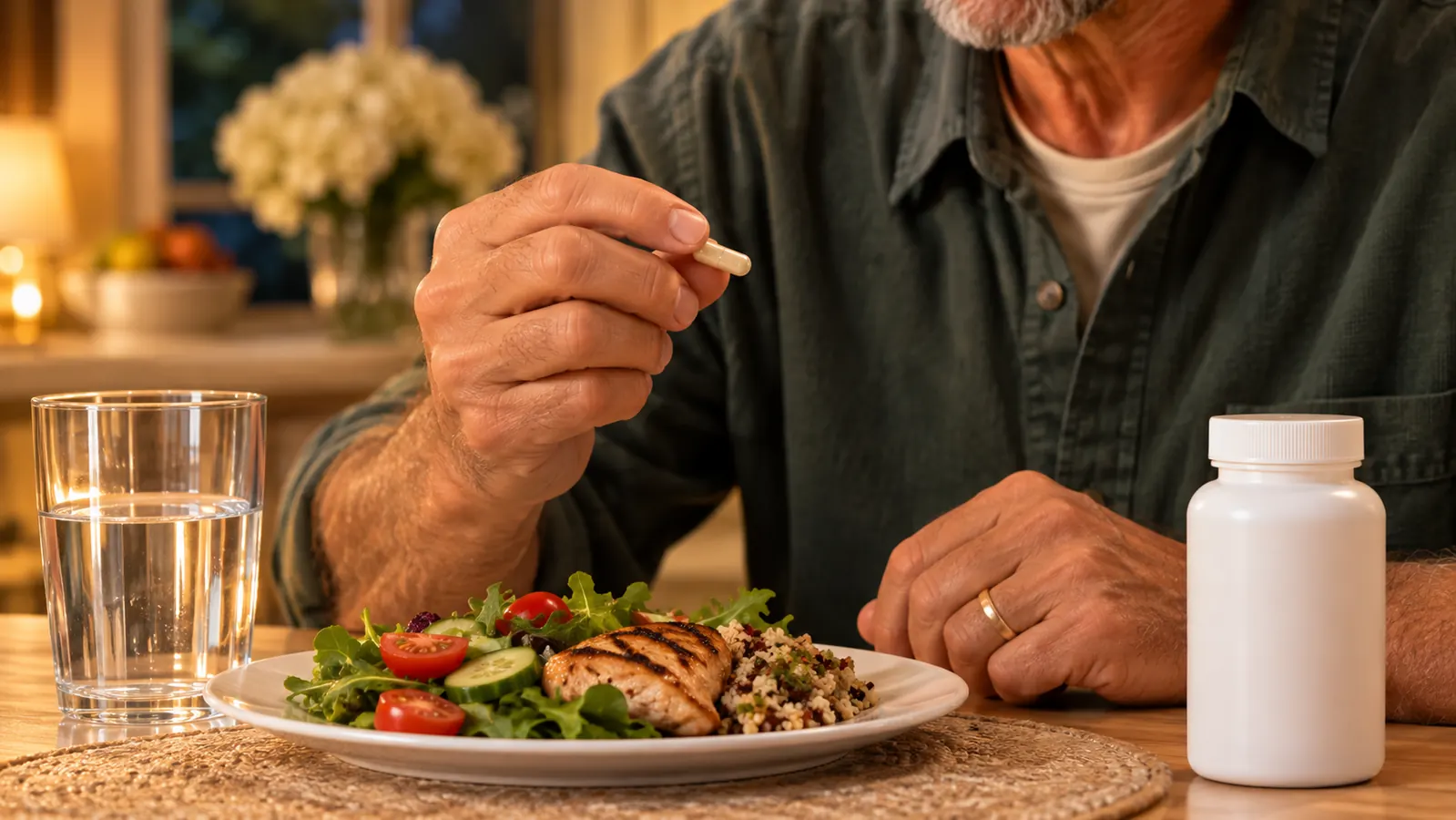
The one bad morning I had with this was my own doing. I took a capsule with a glass of water at 6:30 and nothing else, walked out the door, and by the time I got back my stomach was unhappy in a low-grade way that lasted most of the morning. It has not happened again, because I stopped doing that. Now it goes down with dinner, in the middle of the meal, and that has been the end of it.
Dinner in our house is not fancy. Whatever Dale and I are having, the capsule sits on a napkin next to my fork and I take it when I am about halfway through the plate. If you eat a bigger breakfast than we do, breakfast works just as well. The point is not which meal. The point is that there is food in your stomach before the capsule goes in.
One practical warning I did not expect. If a capsule ever opens up, the powder inside is bright yellow and it will stain a white countertop or a dish towel if you leave it there. Wipe it up with a damp cloth right away. I learned that one in a hurry and I have been careful with the bottle ever since.
Step 3: Take the Serving on the Label and Leave It at That
There is an instinct, when something seems mild and nothing dramatic happens either way, to take two. I don't. The bottle says what the serving is, and I take that, once a day, with dinner. More is not better in my experience of other things, and I have no interest in finding out the hard way at my age.
When I compare bottles in a store, which I do out of habit, the two numbers I look at are the milligrams per serving and the capsule count in the bottle. Those two together tell you how long a bottle actually lasts, and that is the only fair way to compare one brand against another. A big milligram number with 60 capsules behind it is a different product from the same number with 120.
For the record, NatureWise is the one I have stayed with. The honest reason is not that I ran a trial. It is that the label gave me what I wanted to see, the serving and the capsule count held steady between bottles, and I never had a reason to go looking again.
Step 4: Attach It to Something You Already Do Every Day
The bottles that fail in this house are the ones that live in a cabinet and require remembering. We have a two-story house and 14 stairs, and I am not walking down them for a capsule I forgot at two in the afternoon.
So it lives next to the plates, and it goes down at dinner, which is a thing that happens whether or not I am organized that day. The collagen goes in the morning coffee, the glucosamine with breakfast, the MSM with lunch, and the turmeric and the krill oil with dinner. Each one has a slot. If you are only adding one thing, pick the meal you never skip and put the bottle where you eat, not where you store.
If you eat most of your meals out, a bottle at home does you no good. The right place is wherever the meal already is. That is the whole trick and there is not much more to it.
Step 5: Give It Weeks, Not Days, and Write Down What You Notice
This is the step I would underline if I could. I started noticing something around six weeks. If I had quit at ten days I would have told you it did nothing at all. About six weeks in, my right shoulder was not the first thing I thought about on the morning after pickleball. That is a small sentence. It is also the entire report, and I am not going to dress it up into something bigger than it was.
I keep a note in the back of a paper calendar. Not a journal, just a line when something changes. The line for the shoulder says 'still a little stiff, not as loud.' That is what I wrote, and it is exactly as unimpressive as it sounds. But the note is what keeps me from talking myself into or out of something based on how I feel on one random Tuesday.
What I would not do is change three things at once. I tried these one at a time, four months each, with a two week break in between, and I asked Dr. Lowe before every single one. That is the only reason I can tell you anything about the turmeric at all. If you start a turmeric capsule and a new fish oil and a new cream the same week, you have no idea which one to credit and no idea which one to blame.
About six weeks in, my right shoulder stopped being the first thing I thought about on the morning after pickleball. That is a small sentence, and it is my whole report.
What Else Helps
A capsule is not a substitute for using your body, and I would be lying if I said the supplement did the work. The three miles most mornings do more for how my knees feel than anything in that cabinet. So does warming up before pickleball, instead of walking straight onto the court and hitting the first ball like I am 30.
The other things that made a difference for me were unglamorous. Carrying groceries in two trips instead of one. Taking the stairs at a pace my knees agree to first thing, then speeding up once I am warm. Stretching my shoulder against the door frame after I play. Sleeping with the room cool, because a bad night shows up in my knees the next day, every time, without fail.
And I will say the obvious thing, because somebody should. If something hurts in a way that is new, sharp, or getting worse instead of better, that is a conversation for your doctor, not for a bottle in the cabinet. I am not the person to tell you otherwise, and no supplement is.
Sixteen months in, one serving, taken with dinner
If you are going to try one, this is the one I stayed with. NatureWise Turmeric Curcumin, 90 capsules, standardized to 95% curcuminoids. Talk to your doctor or pharmacist before you start, especially if you take a blood thinner or any other regular medication.
Amazon Check Today's Price on Amazon →