

Fifty came and went and nothing dramatic happened. Then one Tuesday morning I came down the fourteen stairs to the kitchen and noticed I was holding the railing the way you hold a handrail on a boat. Not because anything hurt. Because my knees were stiff and I did not quite trust them before coffee. I am 58 now. I walk about three miles most mornings, play pickleball twice a week with my friend Bev, hike a local trail on Saturdays, and dig in a vegetable garden out back until my back tells me to stop. Nobody has ever handed me a diagnosis for the stiffness. It is just there, mostly first thing in the morning, and mostly after a long downhill stretch.
For about a year I tried everything except a supplement. I ignored it. I bought new walking shoes. I bought a foam roller that now lives behind the guest room door. What got me to actually read a label was a friend of mine saying she had been taking Osteo Bi-Flex with breakfast for a couple of years and had stuck with it. So I asked Dr. Lowe about it first, and then I started. I have taken it for 24 months now. What follows is the order I do things in, and the parts I would do differently if I were starting over this morning.
The label I read before I bought anything
Osteo Bi-Flex Triple Strength is a tablet with glucosamine, chondroitin and vitamin C, plus 5-Loxin Advanced. The bottle holds 120 tablets and the label says gluten free. Read the full listing yourself before you decide, and bring the bottle to your pharmacist with your medication list.
Amazon Check Today's Price on Amazon →Step 1: Make the phone call before you make the purchase
The first step is not buying anything. It is a conversation. Glucosamine and chondroitin are dietary supplements, which means they sit on a shelf without a prescription, which means nobody is checking whether they fit with the rest of what you take. I take a blood pressure medication. Dale takes nothing at all, but he is not the one doing this. So before I ordered a bottle, I called my family doctor's office and asked whether it was fine to start, and whether anything I already took would be a problem. Dr. Lowe is my family doctor and has been for years. She asked me to bring the bottle to my next visit so it could go in my file.
If you take a blood thinner, this call is not optional in my book. Ask your doctor or your pharmacist specifically about that, and do it before the first tablet rather than after. The same goes if you take anything else on a regular schedule, or if you are pregnant. I am not a nurse, a dietitian or a trainer and I am not going to pretend to be one on a web page. I am a retired high school office manager who reads labels carefully, and the label does not know your medication list. Your pharmacist does.
One more thing belongs in this step. Glucosamine is often made from shellfish shells. I do not have a shellfish allergy, so that was never a worry for me, but if you do, say so out loud to the pharmacist and let them look at the specific bottle you are holding. That is a five minute question with a real answer, and it costs nothing to ask.
Step 2: Read the label and find out what a serving actually is
The bottle I buy is Osteo Bi-Flex Triple Strength, 120 count. The label lists glucosamine HCl, a chondroitin and MSM complex, and vitamin C, plus something called 5-Loxin Advanced, which the label describes as a concentrated herbal extract. It says gluten free. It is a tablet, not a softgel, not a powder, not a gummy, and it comes in a bottle, not a pouch. The listing describes the product benefits as bone and joint support. Osteo Bi-Flex also calls itself the number one pharmacist recommended brand in joint health, which is a claim printed on the listing, not something I went out and measured.
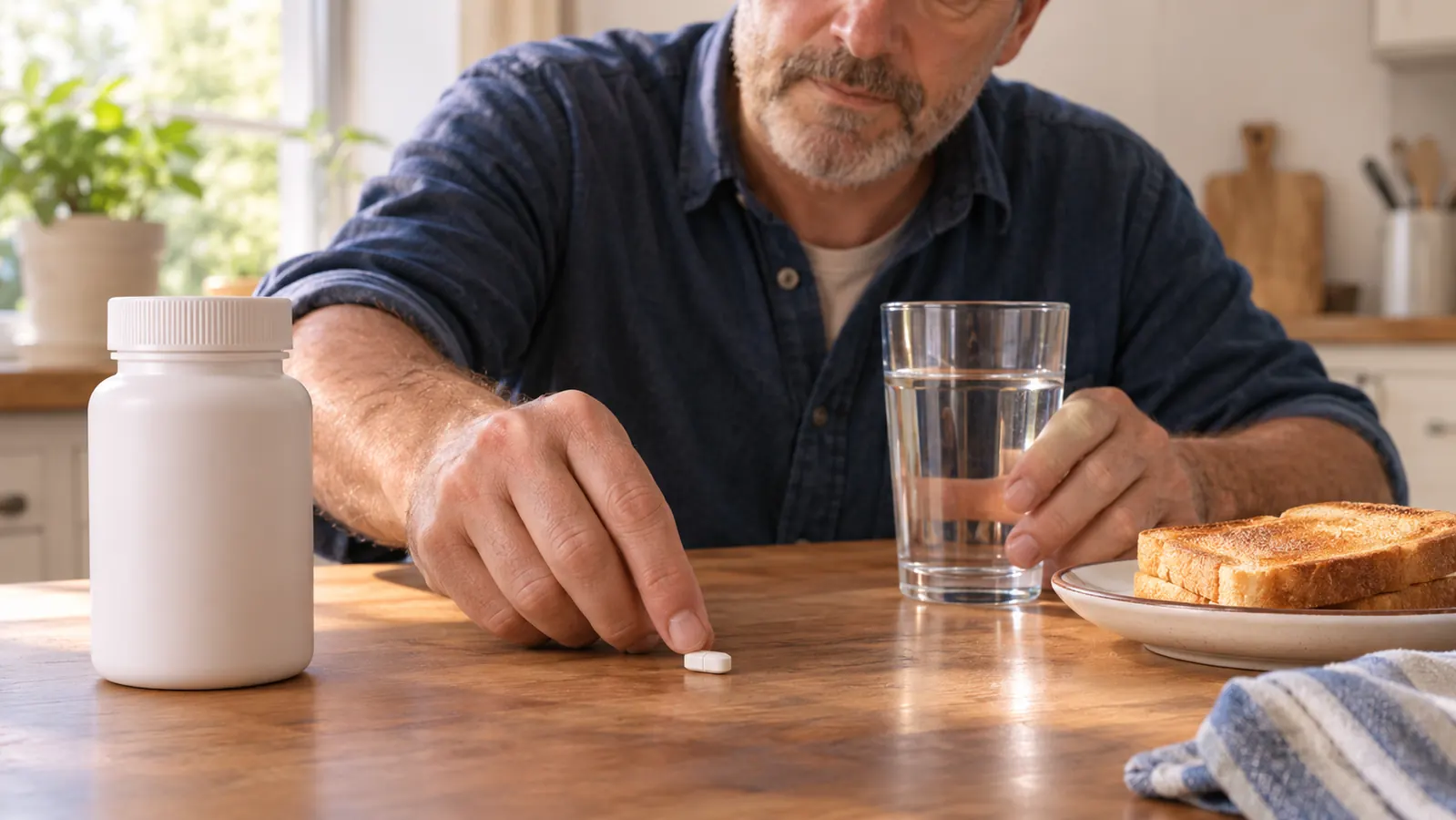
Here is the part most people skip. A bottle count is not a serving count. Before I compare one product to another, I find the line on the label that says how many tablets make a serving, and then I do the arithmetic on how long the bottle really lasts. I am not going to quote milligrams at you, because the numbers that matter are printed on the bottle in your hand and they vary from product to product. What I will say is that two bottles with the same count on the front can last very different amounts of time. Read that line before you compare anything else.
And the honest downside, which I will repeat every time somebody asks me about this product: the tablets are big. Bigger than anything else in my kitchen cabinet. I take mine with a full glass of water and I do not attempt to dry swallow them, and I do not take them at the same moment as my other tablets. If a large tablet is a genuine problem for you, that is worth knowing before you order 120 of them.
Step 3: Anchor it to something you already do every single day
I have started and quit more routines than I can count, and every one of them failed for the same reason: it lived in a cabinet. The supplements that stuck for me are the ones sitting in the open, in the path of something I already do without thinking. Osteo Bi-Flex lives on the counter beside the coffee maker. I take it with breakfast, every morning, because breakfast is the one meal I never skip. That is the entire system. It is not clever. It works.
My mornings go like this. Vital Proteins goes in the coffee. Osteo Bi-Flex goes down with breakfast and a glass of water. Then I walk. NOW MSM sits with lunch, and the turmeric and the krill oil are with dinner, because those are the times that fit around my day. Bev does not take any of it. Dale does not take any of it. I mention the schedule only so you can see the shape of it: the tablet is not a separate event in my life, it is attached to an event that already exists.
When we travel in the Outback, I count out what I need into a small container before we leave and put it in the bag with my toothbrush, because a bottle rattling around in a suitcase is how routines die. If you go away for a weekend and the bottle stays home, you have just learned something about where your routine actually lives.
Step 4: Give it a fair stretch and keep a plain note
This is the step where most people quit, and I understand why. A supplement is not a light switch. There is no moment where you feel something click on. If you are expecting a clear before and after in the first week, you will decide it did nothing and stop, and you will never know either way. I decided before I started that I would give it a fair stretch of months and write down what I noticed instead of trying to remember it.
What I noticed, and this is all of it: about eight weeks in, the fourteen stairs to the bedroom felt a little easier first thing in the morning. Not effortless. A little easier. There were mornings before that where I could not have told you whether it was doing anything at all, and there are still mornings now where my knees are stiff and the stairs are slow. I am telling you what happened in my routine. I am not telling you what will happen in yours, and I am not going to put a date on it for you, because I do not know.
The note itself is nothing fancy. I keep a lined pad on the side of the fridge and I write one line a week. How the stairs felt. How the right shoulder felt after pickleball. Whether I slept well. Three or four words, no scoring system. After a couple of months you have a page of your own handwriting instead of a vague feeling that something may or may not have changed. That page is worth more than any review you will read online, including mine.
About eight weeks in, the stairs felt a little easier. That is the whole claim, and I am not going to dress it up.
Step 5: Build the rest of the week around it, not on top of it
A tablet is a small thing in a week that also contains three mile walks, two pickleball games, a Saturday hike and a garden that needs weeding. If I took the tablet and sat in a chair, I would have a very different story to tell, and it would not be a good one. The walking is what keeps the walking possible. That is not a supplement claim, that is just how my week is built, and the tablet sits inside the week rather than replacing any part of it.
Small changes made more difference to my mornings than I expected. A warm shower before I come downstairs. Standing up and moving around every so often instead of sitting through a whole book. Decent shoes with some cushion left in them, replaced before they are truly dead. And on the long downhill stretches on the Saturday trail, I slow down and shorten my stride instead of leaning back and letting gravity do the work. None of that is medical advice. It is just what an active 58 year old does when she would like to keep being an active 58 year old.
The last piece of this step is patience with yourself. I have had two stretches in the past 24 months where I stopped noticing anything and wondered whether I was wasting money. Both times I kept taking it, kept walking, and kept writing the line on the pad. I am still taking it. That is my decision, made with my own routine and my own doctor, and it does not obligate you to make the same one.
What Else Helps
Two things made a bigger difference to me than any bottle in the kitchen, and neither of them is a supplement. The first is sleeping properly. When I sleep badly, my mornings are worse, full stop, and no tablet fixes a short night. The second is not stopping. It is tempting, on a stiff morning, to sit down and wait for it to pass. For me the stiffness eases when I move, gently, and gets worse when I sit and think about it. A slow lap around the block before breakfast beats an hour on the couch.
The other thing I would say is to keep your expectations small and specific. Do not aim for a transformation. Aim to notice whether the stairs feel different in eight weeks, or whether the morning after pickleball is easier than it used to be. Small, specific questions get honest answers. Big vague ones get wishful thinking, and wishful thinking is how people end up buying six bottles of something and taking none of them.
And if you have a friend like Bev, tell her what you are doing. Not so she will agree with you, because she will not, but because saying it out loud is how a routine becomes real. She asked me what was in the bottle, I read her the label, she shrugged and said she would rather just keep playing. That is a perfectly good answer too.
Start with the label, not with the hype
120 tablets. Glucosamine, chondroitin, vitamin C and 5-Loxin Advanced, in a gluten free tablet. Talk with your doctor or pharmacist first, especially if you take a blood thinner or have a shellfish allergy, then decide for yourself.
Amazon Read the Full Label on Amazon →