

I did not start taking an omega-3 because a podcast told me to. I started because my knees were stiff every single morning on the way down the 14 stairs to the kitchen, and because my right shoulder ached the day after pickleball, and because at 58 I would like to keep hiking the local trail on Saturdays for a while yet. I asked Dr. Lowe about it first. She said it was reasonable to try, told me to bring the bottle in so she could look at it, and told me to check with the pharmacist about interactions. That was the whole conversation. No promises were made by anybody.
What follows is not medical advice and I am not a doctor, a nurse, a dietitian or a trainer. It is simply how I worked a krill oil softgel into a week that already had three-mile walks, two pickleball games and a vegetable garden in it, and what I would tell a friend who asked. The product I landed on and have kept for twelve months is MegaRed Antarctic Krill Oil, the extra strength version, 500mg, in softgel form. I will get to the label details in a minute, because the label is the only place any of us should be getting numbers from.
The bottle I have kept on the shelf for twelve months
MegaRed Antarctic Krill Oil, extra strength, 500mg per softgel, 90 servings per container. Small softgels, vanilla-coated, no fishy aftertaste for me. Check the current label and today's price before you decide anything.
Amazon Check Today's Price on Amazon →Before Step One: What the Label Actually Says
I read labels now in a way I did not ten years ago, mostly because I got tired of buying things that turned out to be three servings per container. Here is what the MegaRed box tells you, and I am only repeating what is printed on it and in the listing.
Each softgel is 500mg of krill oil, extra strength, with EPA and DHA, and astaxanthin listed as a special ingredient. The container holds 90 servings. The softgels are small and the box lists a vanilla flavor. The allergen line says gelatin, and it says plainly that krill is a shellfish. That single line is the most important one on the package for a lot of people, and I will come back to it. The listed product benefit is antioxidant, and the recommended use on the package is heart health. The diet type is listed as keto.
What the label does not tell you is how you will feel. Nothing on a supplement box can tell you that, and anybody who says otherwise is selling something. So the rest of this is about the practical part: how you actually build it into a week.
Step 1: Ask Your Doctor or Pharmacist First, Out Loud
This is step one and it is not a formality I am putting at the top to cover myself. Krill is a shellfish. If you have a shellfish allergy, that is a hard stop and you should not be taking this at all. If you take a blood thinner, or any prescription medication, or you are pregnant, that is a conversation with your doctor or pharmacist before you open the box, not after.
I asked Dr. Lowe, and then I did the thing she suggested, which was to bring the actual bottle to the pharmacy counter and ask the pharmacist to look at it against what I already take. That took eight minutes. It is the cheapest and most useful eight minutes in this entire process, and it is the one step people skip because they are in a hurry at the store.
I will say the plain version: I am not qualified to tell you whether this is right for you. Your pharmacist is, or your doctor is. Ask them. Then come back and read the rest, which is only about fitting it into your routine.
Step 2: Pick One Time of Day and Never Move It
The reason most supplements fail is not the supplement. It is that people take them for eleven days and then forget for a week. I know because I did that with a vitamin D bottle for two winters running.
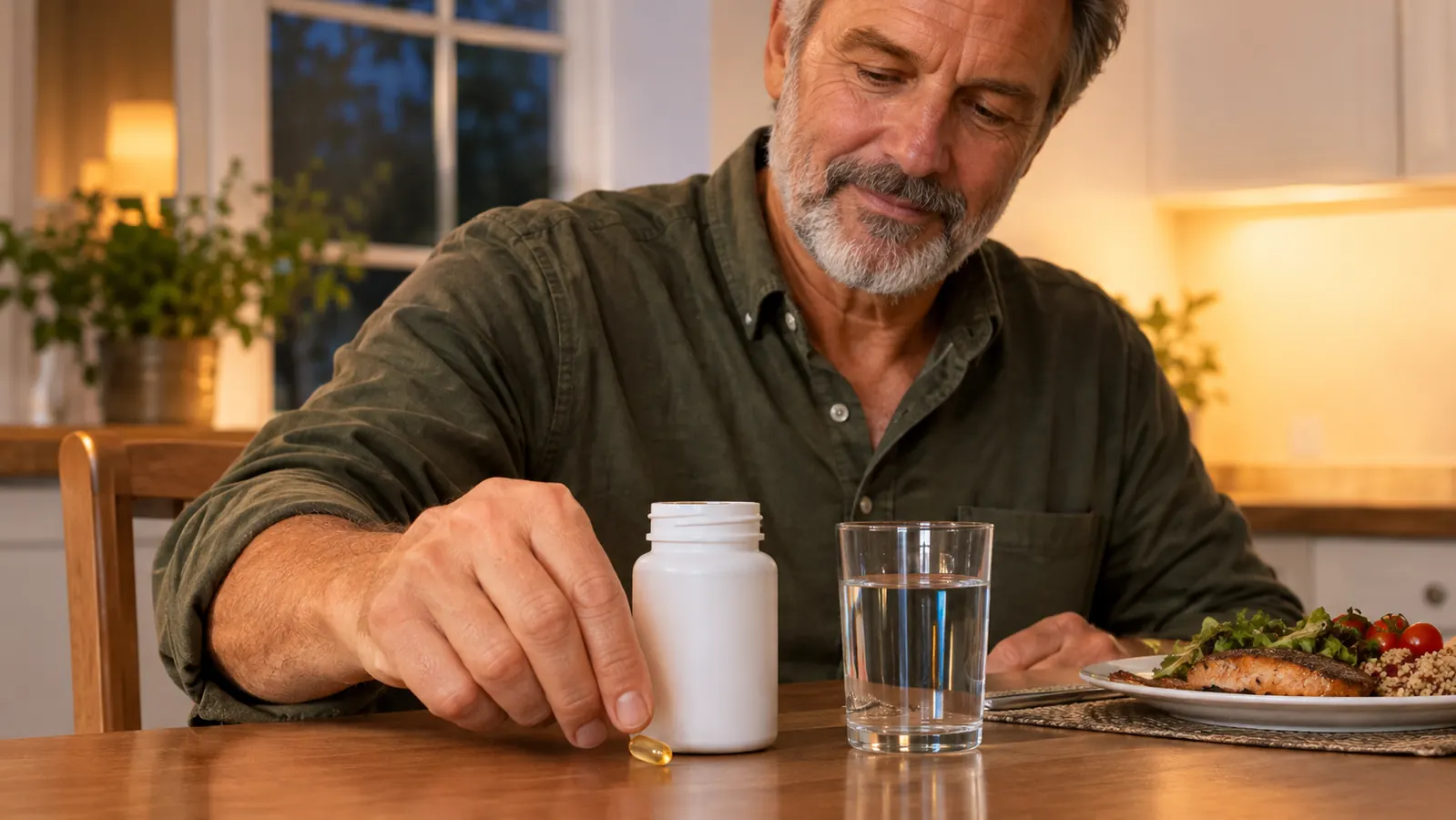
What finally worked for me was tying the softgel to a meal I never skip. Dinner, in my case. It sits next to the turmeric on the counter by the sink, and I take both when I sit down to eat. Not in the morning, because my mornings are a walk and coffee and out the door. Not at lunch, because lunch is often a sandwich standing up. Dinner is the one meal in this house that happens at a table.
The package does not tell you a time of day, so pick the one that already exists in your life and put the bottle where you will physically see it. If you eat breakfast at a table every day, do breakfast. If you take other things with dinner, put it with those. The point is not the hour. The point is that you stop having to remember.
Step 3: Take the Serving on the Label, Not a Bigger One
I want to be careful here because this is where people get creative. The serving is the serving. The label says what it says. Take the serving on the label and do not double it because you had a hard pickleball game, and do not skip it the next day to make up for it.
I have watched friends treat supplements like coffee, where more feels like it must be doing more. It does not work that way and I would rather say so plainly than be encouraging about something I do not know. If you think you need a different amount, that is a question for your doctor, not a decision you make at the counter with the bottle already open.
The other half of this step is the two-week rule I use for anything new. I take it exactly as the label says for a stretch of weeks before I decide anything about it. No judging it on day four. No deciding it is useless on day nine when I have a bad morning on the stairs for unrelated reasons, like having spent the previous afternoon hauling mulch bags around the garden.

Step 4: Write It Down Once a Week, and Be Boring About It
This is the step I almost left out because it sounds like homework, and it is the one I would keep if I could only keep one. Once a week, on Sunday evening, I write three things in a small notebook: how the stairs felt that morning, how the right shoulder felt the day after pickleball, and whether I took the softgel every day or missed any.
That is it. Three lines. It takes ninety seconds. What it gives you is something to actually look at instead of a vague feeling that you maybe feel better, or maybe do not, or maybe it was the weather. Memory is unreliable about this. I was sure my knees had been worse in March until I read back and found out they had been about the same since January.
A weekly note also catches the thing that matters most, which is whether you are actually taking it. A bottle that lasts 90 servings should last about three months at one a day. If yours is lasting longer than that, the notebook will tell you why, and it will not be the supplement's fault.
Step 5: Give It Weeks, Not Days, and Set an Honest Check-In
I took MegaRed alone for four months before I made any judgment at all, and I asked Dr. Lowe at the start what a fair stretch would be. I am not going to hand you a timeline and tell you what will happen in it, because I do not know, and neither does anybody writing a label. What I will tell you is what happened with me, and you can do what you like with it.
About twelve weeks in, I honestly could not point to one single moment where something changed. There was no morning where I came down the stairs and thought, well, that is different. What I noticed, when I read back through the notebook, was that the mornings overall were a little easier than they had been in the winter. That is all. It is a modest thing and I am not going to dress it up.
The other thing I noticed was the practical side, which surprised me more. I had tried a plain fish oil years back and could not get past the aftertaste, and I gave it up inside a month. These softgels are small and they carry a vanilla flavor per the box, and for me there was no fishy repeat afterward. That is not a benefit you will read about in a study. It is the reason I am still taking it at twelve months, and it is the honest reason a lot of people stick with anything.
About twelve weeks in, I could not point to one single moment. Just easier mornings overall, and a bottle I did not dread opening. That was the whole of it.
What Else Helps
If your goal is to keep walking, hiking and playing pickleball, a softgel is one small part of a larger week, and I would be lying if I let it stand alone. The things that have helped me most are unglamorous. Walking three miles most mornings. Not sitting for two hours straight after a hike. Warming up before pickleball instead of walking onto the court cold and swinging. Doing the stretches the physical therapist gave me after my shoulder first started complaining, which I did faithfully for six weeks and then, honestly, less faithfully after that.
The other thing that helped was picking one thing at a time. I have taken five different supplements over the past couple of years, one at a time, each for four months, with a two-week break in between, and always after asking Dr. Lowe. That is the only way I have found to have any idea what is doing what. If you start three bottles on the same Tuesday, you have learned nothing by Christmas except that you are buying three bottles.
And I will say the thing I say in every one of these pieces because it is true: a supplement did not fix my knees and it will not fix yours. What I have is a routine that I can keep, a notebook that keeps me honest, and a doctor who knows what is in my cabinet. That is a reasonable place to be at 58. If you want to know which of the five products I would keep if I could only keep one, the krill oil is not it. Osteo Bi-Flex would be, and that is a different article.
If you have asked your doctor, here is the bottle I use
MegaRed Antarctic Krill Oil, extra strength, 500mg per softgel with EPA, DHA and astaxanthin, 90 servings per container. Small softgels. Krill is a shellfish, so skip it entirely if you have a shellfish allergy, and talk to your pharmacist about blood thinners first.
Amazon Check Today's Price on Amazon →